


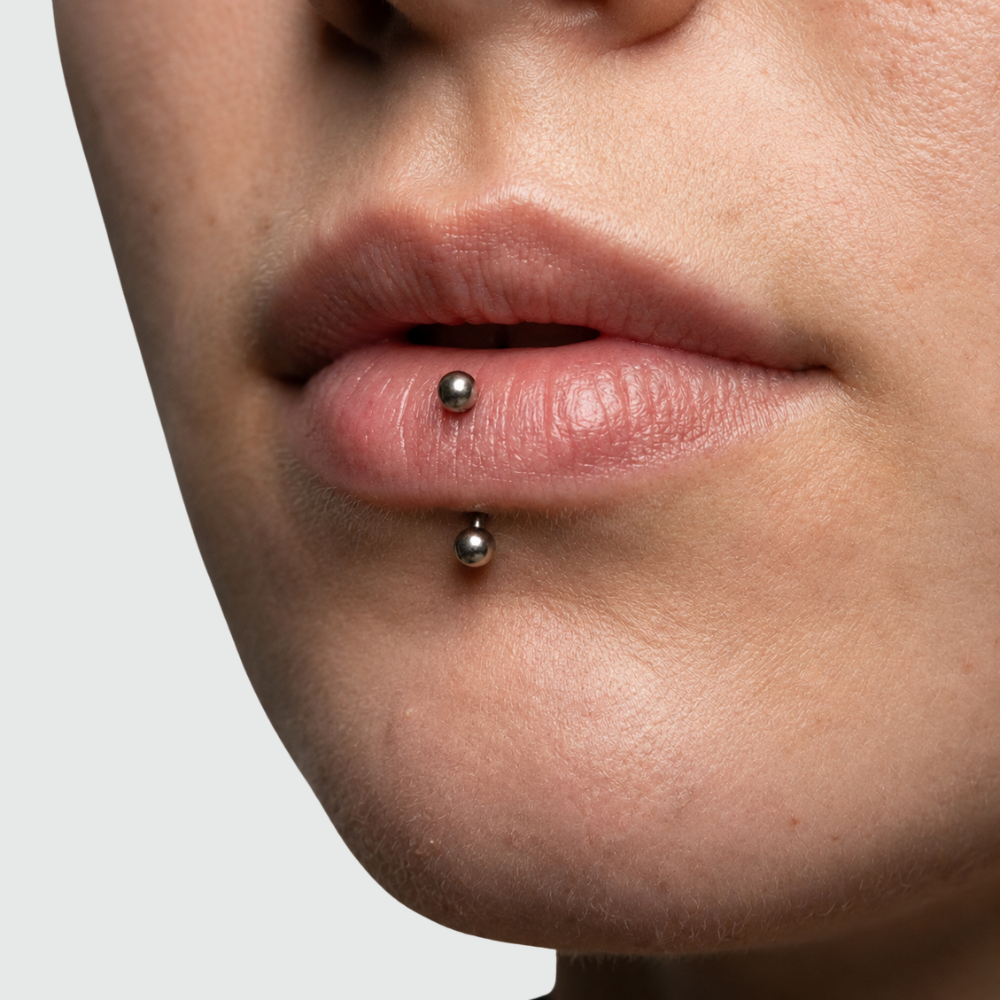
Vertical Labret
Vertical Labret, i.e. a vertical piercing of the lower lip, is currently an absolute hit and one of the most photogenic facial piercings! Shiny balls or crystals located on the very red lip and just below it are incredibly eye-catching, adding fullness and character to the lips.
The biggest advantage of this piercing? There is no contact with your teeth and gums at all! If you want to wear an earring around your mouth, but you are paralyzed by the idea of visiting the dentist, Vertical Labret is made for you. W Piercing Planet We have prepared a loose but informative guide that will help you heal your lip without stress.
What is Vertical Labret Piercing?
Unlike the standard Labret (which goes horizontally under the lip straight into the mouth), the Vertical Labret is performed only in external tissue.
The needle enters vertically under the lower lip and exits perfectly in the center of the lip area (from above). The earring does not penetrate the inside of your mouth, does not touch the mucous membrane, saliva, or even your enamel!
Important – Anatomy: To perform this piercing, your lower lip must be sufficiently full and have a clearly defined, "rolled" edge into which the piercer can insert the needle. In the case of very narrow and flat lips, the piercing may migrate (be pushed out by the body).
Does a Vertical Labret piercing hurt?
Lip red is a place full of nerve endings, so the treatment is quite noticeable. Pain is an individual matter, but it is most often assessed as: 4 to 5 on a 10-point scale. The sting itself is literally a second of a sharp pinch.
What do you have to take into account immediately after leaving the studio?
- The "Kylie Jenner" effect: The lower lip will react with massive swelling. It will be tense, sensitive and up to twice its size. It's normal!
- Long earring to start with: Due to the swelling, the piercer will insert a very long rod. It will look comical, but it is necessary for the tissue to have room to regenerate.
Healing time and care of the Vertical Labret
Due to the fact that the lip is a moving part of the face, healing requires patience and gentleness.
- Swelling goes down: from 2 to 4 weeks.
- Complete healing of the wound: from 3 to even 6 months.
The most important rules:
- Drinking and eating in a new style: At first, give up sandwiches and eating out of hand. Cut food into small pieces and throw it straight onto your teeth. A paper straw will become your drinks' best friend!
- Dry mouth nightmare: As it heals, your lips will become dry, sore and cracked. Unfortunately, You are completely prohibited from using protective lipsticks, balms and lip glosses! Cosmetics getting into the wound will cause a purulent infection. Drink plenty of water to hydrate your body from the inside.
- Brushing your teeth and face: Do this carefully so as not to catch the brush or towel on the upper ball on the lip.
How to care for a fresh piercing? (Principles of care)
- Don't touch: Avoid touching the earring with dirty hands and refrain from "spinning" it.
- Cleanse regularly: Wash the piercing site 2-3 times a day with sterile saline solution.
- Avoid chemicals: Avoid using hydrogen peroxide, alcohol or antibiotic ointment. They may irritate the wound and delay healing.
- Be careful with your hair and clothes: Make sure that shampoo or conditioner does not remain on the ear after bathing. Be careful when putting on sweaters!
What jewelry for Vertical Labret?
W Piercing Planet We want to make customers aware that titanium is the safest material for piercings - especially in such sensitive, facial places as the lip area.
During healing:
A straight labret is NEVER worn with this piercing! The gold and only standard is curved barbell – Banana (Curved Barbell) made of hypoallergenic material Titanium G23. Its curvature perfectly fits the natural profile of the lip.
- Rod Thickness: Most often 1.2 mm.
- Starting Length: Usually 10 mm or 12 mm to cover all the swelling.
Downsize is a must! When the lip returns to normal size (after about 4 weeks), the upper ball will start to stick out significantly. If you do not replace it, you will start to catch cutlery on it, which will lead to the formation of painful blisters (granulation) and tearing of the earring. Run to the piercer for a shorter banana (usually 8 mm or 6 mm)!
Decorative jewelry for Vertical Labret Piercing


- Titanium
- Internal Thread
Titanium Labret with Ball - with Internal Thread
Choose your option


- Titanium
- Internal Thread
Titanium Decorative Labret - Diamond


Choose your option


- Titanium
- Internal Thread
Titanium Decorative Labret - Flat Cubic Zirconia
Choose your option


- Titanium
- External Thread
Titanium Labret with Ball - with External Thread

Choose your option


- Titanium
- Internal Thread
Titanium Decorative Labret - Three Cubic Zirconia Leaves


Choose your option


- Titanium
- Internal Thread
Titanium Decorative Labret - Three Zircons


Choose your option


- Titanium
- Internal Thread
Titanium Decorative Labret - with Cubic Zirconia
Choose your option


- Titanium
- Internal Thread
Titanium Decorative Labret - Three Leaves with Zircons
Choose your option
Vertical Labret Piercing - Questions and Stories
Does Vertical Labret rot your teeth or damage your gums?
Does Vertical Labret rot your teeth or damage your gums?
Absolutely not! This is the biggest advantage of this piercing. The piercing is located entirely on the outside of the lip (on the skin and labial area). At no time does it come into contact with the inside of the mouth, mucous membrane, teeth or gums, making it 100% safe for them.
Can I put a ring in the Vertical Labret?
Can I put a ring in the Vertical Labret?
The Vertical Labret piercing ring is not worn during or after healing. This is due to the fact that the piercing is vertical on the lip itself. In order for the ring to encompass the lip, it would have to go across to the inside of the mouth (like a regular Lip/Labret piercing). If you want a circle effect, your choice should be the classic Labret, not the Vertical Labret.
Will I have a large scar on my lips after piercing?
Will I have a large scar on my lips after piercing?
The skin on the lip piercing regenerates exceptionally well, although this piercing is classified as superficial. After complete healing and permanent removal of the piercing, a small point resembling an enlarged skin pore may remain at the injection site (under the lip), and on the lip itself there may be a tiny, almost invisible scar that naturally blends with the structure of the lips (easy to cover with lipstick).
When can I use lipstick after getting a lip piercing?
When can I use lipstick after getting a lip piercing?
Applying any lipstick, lipstick, lip gloss or matte tint directly to a fresh wound is a disaster - it will clog the piercing canal and cause infection. Colored cosmetics and moisturizing balms can be safely used in the mouth only after the canal has completely healed, which usually takes 3 to 4 months. Until then, you need to moisturize yourself from the inside (drinking plenty of water).


