


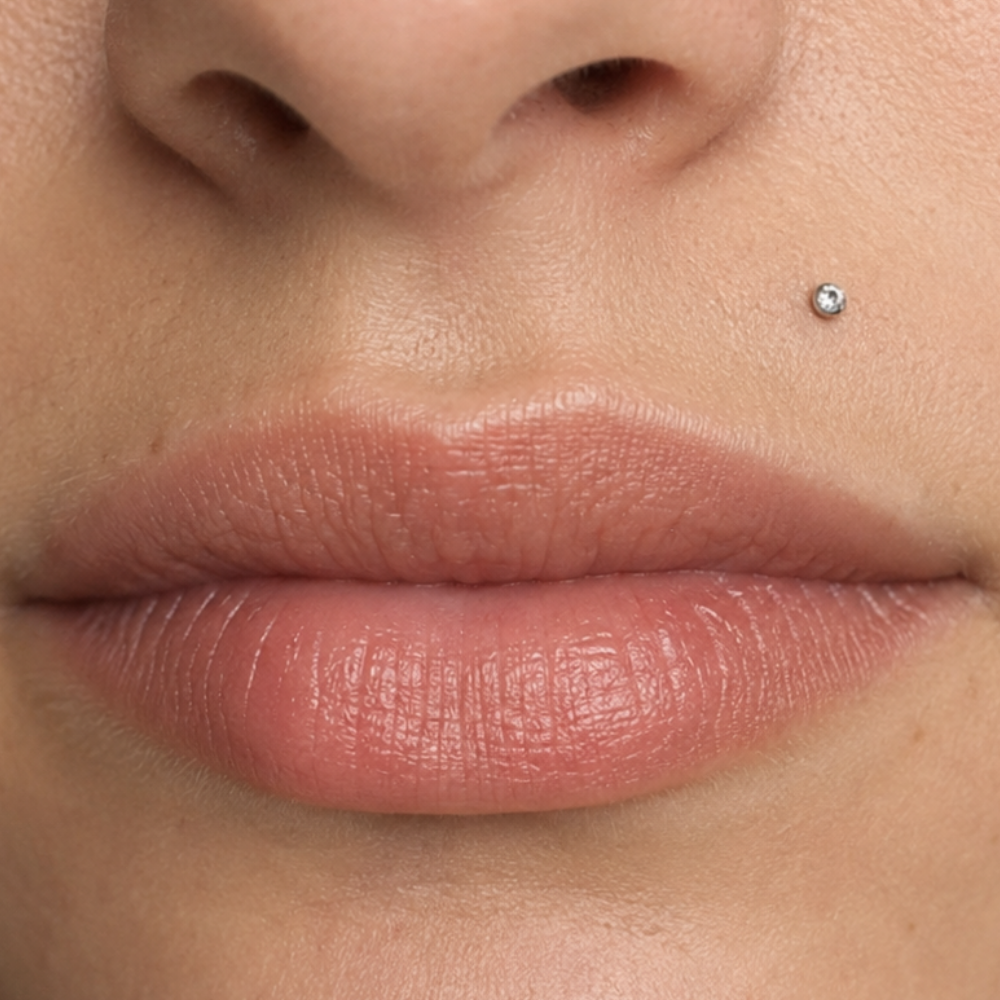
Monroe Piercing
Monroe is a piercing that owes its name and popularity to the legendary pop culture icon – Marilyn Monroe. Located asymmetrically above the upper lip, this earring is intended to imitate the star's characteristic mole. The subtly shimmering crystal in this place incredibly highlights the smile, adding coquetry and class to the face.
However, it should be remembered that, like Labret or Medusa, it is a piercing that comes into contact with the inside of the mouth. It therefore requires perfect hygiene and the absolute use of safe materials. W Piercing Planet We have prepared a complete guide for you that will help you safely heal this phenomenal detail.
What is Monroe Piercing?
The procedure involves piercing the tissue above the upper lip (from the side) through - from the outside of the skin to the inside of the mouth.
Customers often confuse the names of piercings above the upper lip. The principle is very simple:
- Monroe Piercing: Located after left side face (like Marilyn's mole).
- Madonna Piercing: Located after right side face (imitating the mole of the singer Madonna).
- Tip: If you decide to do both of these piercings at the same time (symmetrically on the left and right sides), you will get an arrangement called Angel Bites.
Does a Monroe piercing hurt?
The tissue above the upper lip has a large number of nerve endings, which makes the sting noticeable. Pain is most often assessed as: 4 on a 10-point scale.
However, the real challenge for your appearance in the first days is not the pain, but the body's natural defense reaction:
- Asymmetric swelling: The upper lip will swell very quickly, and since the piercing is only on one side, the swelling will be asymmetrical. Your lips may look slightly "crooked" for a few days.
- Long sticking rod: To give the tissue room to swell, the piercer must put an unnaturally long earring on you, which at first will be very visible from the outside and may irritate the inside of your mouth.
Monroe healing time and care
W Piercing Planet our mission is complete education. Your earring is in daily, 24-hour contact with the mucous membrane, gums and tooth enamel. Choosing cheap metal alloys is a direct path to complications.
During healing:
Standard for Monroe is straight Labret with flat disc at the back.
- Why only Tytan G23? Titanium is a 100% biocompatible material. It does not react with saliva, does not rust and does not contain released nickel (unlike surgical steel). It guarantees the fastest and safest healing without the risk of allergies.
- Rod Thickness: Standard is 1.2mm.
- Starting Length: Typically 10 mm to 12 mm due to the large initial swelling of the lip.
Downsize (Shortening the bar) – Protect your teeth!
When the asymmetric swelling disappears (usually after 3-4 weeks), the long titanium rod will begin to rest against the upper teeth and catch the gums during every conversation and smile. Leaving it in the lip will cause the gums to sag (recession) and physically wear down the enamel. You must go to your piercer for the so-called downsize – replacing the rod with a shorter one that fits perfectly to the inside of the mouth (e.g. 6 mm or 8 mm).
How to care for a fresh piercing? (Principles of care)
- Don't touch: Avoid touching the earring with dirty hands and refrain from "spinning" it.
- Cleanse regularly: Wash the piercing site 2-3 times a day with sterile saline solution.
- Avoid chemicals: Avoid using hydrogen peroxide, alcohol or antibiotic ointment. They may irritate the wound and delay healing.
- Be careful with your hair and clothes: Make sure that shampoo or conditioner does not remain on the ear after bathing. Be careful when putting on sweaters!
What jewelry for Monroe piercing?
Choosing the right jewelry is the key to success. Depending on the stage of healing, you will need different piercings.
Starter jewelry (fresh piercing)
To begin with, the piercer always puts on longer jewelry to accommodate the natural swelling (swelling) of the ear that occurs after the procedure. The best choice is Labret made of surgical titanium (G23). Titanium is hypoallergenic, nickel-free and ideal for the healing process.
- Rod Thickness: Typically 1.2 mm.
- Starting rod length: 7 mm – 9 mm (selected individually by the piercer).
Jewelry after healing (downsize)
When the swelling goes down (usually after 3-4 weeks), you should return to the piercer for the so-called downsize, i.e. replacing the rod with a shorter one (e.g. 5 mm - 6 mm). Once the canal has completely healed, a whole world of styling opens up to you! You can wear rings, earrings, chains and richly decorated caps.
Check out our Titanium Jewelry


- Titanium
- Internal Thread
Titanium Labret with Ball - with Internal Thread
Choose your option


- Titanium
- Internal Thread
Titanium Decorative Labret - Diamond


Choose your option


- Titanium
- Internal Thread
Titanium Decorative Labret - Flat Cubic Zirconia
Choose your option


- Titanium
- Clicker
Titanium Segment Clicker with Cubic Zirconias Rim - Circle
Choose your option


- Titanium
- External Thread
Titanium Labret with Ball - with External Thread

Choose your option


- 316L steel
- Clicker
Steel Segment Clicker with Zircons - Circle
Choose your option


- Titanium
- Internal Thread
Titanium Decorative Labret - Three Cubic Zirconia Leaves


Choose your option
Monroe Piercing - Questions and Stories
Does Monroe Piercing damage teeth?
Does Monroe Piercing damage teeth?
Like any other lip piercing, Monroe carries the risk of enamel damage or gum recession, but these can be minimized! This problem almost exclusively affects people who do not undergo the mandatory replacement of the earring with a shorter one after the swelling subsides, or who have a harmful habit of biting the jewelry with their teeth. A well-fitting (short) labret will gently "press" into the mucosa from the inside (so-called nesting), without causing friction against the teeth while speaking.
Will there be a "hole" on my face after removing the Monroe piercing?
Will there be a "hole" on my face after removing the Monroe piercing?
Lip piercings heal quite well from the outside, but since it's an all-through piercing, it always leaves a mark. After permanent removal and healing of the piercing, a tiny, slightly recessed point usually remains on the skin above the lip (often resembling a natural, light mole or an enlarged pore). It can usually be easily camouflaged with a bit of concealer.
What should I do if the flat disk on the back of my earring is stuck in my mouth?
What should I do if the flat disk on the back of my earring is stuck in my mouth?
Pay attention to the degree of this phenomenon. If your lips are swollen so much that the tissue completely covers the disc and "devours" the piercing (embedding), causing throbbing pain, immediately go to the piercer to replace the rod with a longer one (so-called up-size)! However, if the piercing is healed, a short rod is inserted, and the disc only gently "lies" in a shallow depression of the mucous membrane without any signs of pain, this is a completely natural protective process of the body, the so-called nesting.
I have a lump near my earring - what is it?
I have a lump near my earring - what is it?
A small "lump" is most often granulation tissue, which is caused by mechanical irritation (e.g. sleeping on the ear, getting caught in clothes) or a wrong angle of the piercing. Don't squeeze it! Consult your piercer and follow appropriate saline care.


