


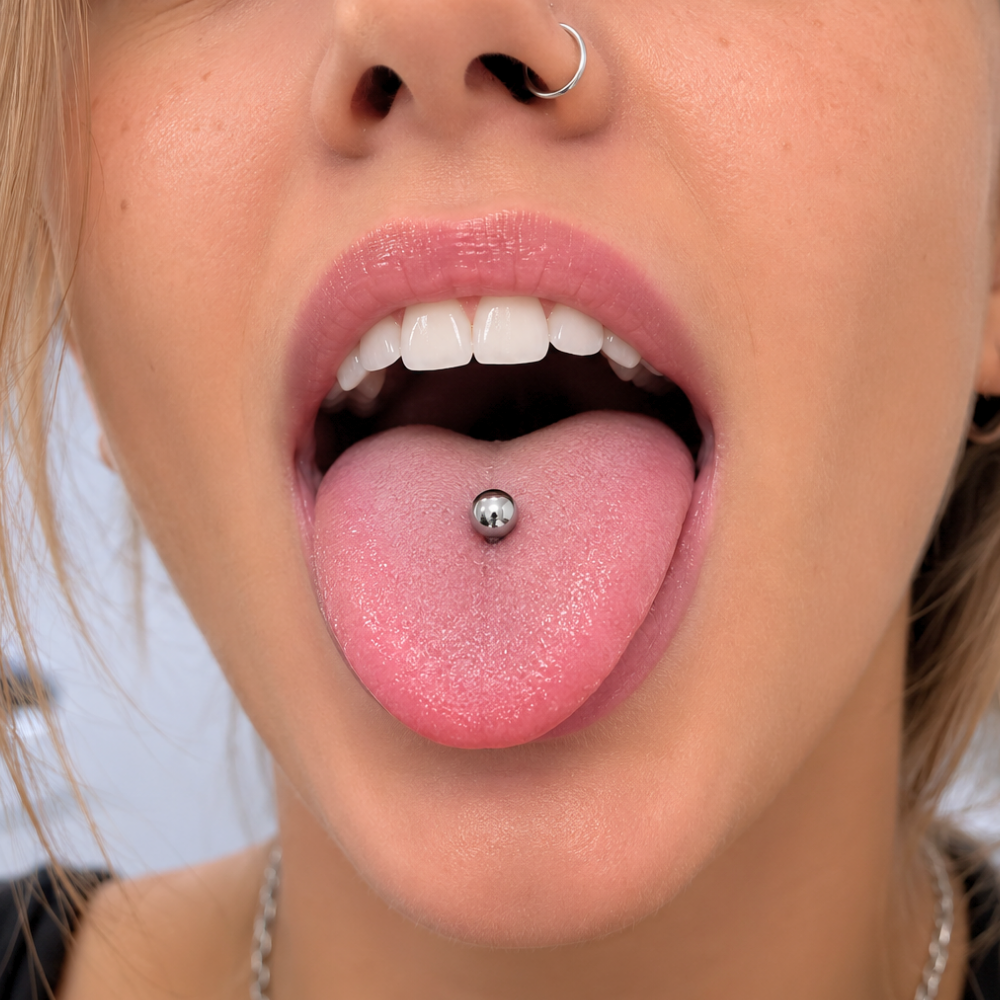
Tongue Piercing
Tongue earring it is one of the most iconic and popular types of piercings in history. Although it remains invisible from the outside, when your mouth is closed, one word or a smile is enough to completely change your image.
This piercing is fascinating, but also raises many concerns - especially in the context of dental safety and the allegedly excruciating pain. W Piercing Planet we dispel myths! We have prepared a comprehensive guide for you that will help you safely survive the healing process and enjoy this unique piercing without worrying about your smile.
What is Tongue Piercing?
A classic tongue piercing runs vertically, exactly through its center, bypassing the main blood vessels.
Anatomy is the absolute basis: Not everyone can leave the studio with a tongue piercing! Before the piercer picks up the needle, he must carefully examine the inside of your mouth for two factors:
- Sublingual frenulum: It is a membrane that connects the bottom of the tongue with the floor of the mouth. If it is too short or reaches too far forward (so-called "attached tongue"), it may be impossible to perform a classic piercing.
- Two main veins: There are two large, visible veins running under the tongue. The piercing channel must be routed to safely pass them. Damage to these vessels may result in serious hemorrhage.
Does tongue piercing hurt?
This is the biggest surprise for most customers: the tongue piercing itself practically does not hurt! The tongue is a muscle, and the needle passes between its fibers. Pain is most often rated only at 2 to 3 on a 10-point scale.
However, the real "fun" begins a few hours after leaving the studio:
- Swelling: The tongue swells dramatically and rapidly. It will likely be significantly enlarged on the second and third days after surgery.
- Long earring (antenna): Due to the swelling, the piercer will put an unnaturally long barbell on you, which will be very uncomfortable at first.
- Lisp: A swollen muscle and a long piece of metal in your mouth will make your diction worse for a few days. A slight lisp is normal. It will go away as soon as the swelling goes down!
Healing time and tongue care
The tongue is the best-supplied muscle in our body, and the oral mucosa has amazing regenerative abilities. Thanks to this, the piercing heals record-breakingly quickly!
- The initial stage (going down the swelling and the worst discomfort): from 7 to 14 days.
- Complete healing of the canal: from 4 to 8 weeks.
The most important rules for surviving with a new earring:
- Ice relief: In the first days, cool drinks, ice cubes (to suck, not bite!) and water ice will be your salvation, helping to shrink the swelling.
- Diet modification: For the first week, forget about hard, hot, spicy and chewy food. Choose cold soups, creams, yogurts, purées and cocktails. Rinse your mouth with alcohol-free dental mouthwash after each meal!
- A ban on dairy products with live bacteria cultures? Some piercers recommend avoiding kefir, buttermilk and unpasteurized milk in the first days so as not to introduce additional bacteria into the fresh wound.
- Save language: Speak as little as possible. Excessive tongue movement in the first days only increases the swelling and pain.
- Dental hygiene: Brush your teeth after each meal, but use a new toothbrush with soft bristles to avoid irritating the wound.
How to care for a fresh piercing? (Principles of care)
- Don't touch: Avoid touching the earring with dirty hands and refrain from "spinning" it.
- Cleanse regularly: Wash the piercing site 2-3 times a day with sterile saline solution.
- Avoid chemicals: Avoid using hydrogen peroxide, alcohol or antibiotic ointment. They may irritate the wound and delay healing.
- Be careful with your hair and clothes: Make sure that shampoo or conditioner does not remain on the ear after bathing. Be careful when putting on sweaters!
What jewelry for tongue piercing?
The choice of material and size is absolutely critical when it comes to the tongue. Bad decisions can cost you visits to the dentist.
During healing:
The gold standard is Straight Barbell.
- Only safe Tytan G23: Your tongue needs a sterile environment. Titanium does not rust in saliva, does not contain nickel and is 100% biocompatible.
- Rod Thickness: 1.6 mm (thickness that ensures stability and does not "cut" the tissue under muscle pressure).
- Starting Length: Typically from 18 mm to even 22 mm, depending on the natural thickness of your tongue and expected swelling.
Downsize (Shortening the bar) – SAVE YOUR TEETH!
When the tongue returns to normal size (usually after about 2-3 weeks), the barbell will become much too long. An earring that is too long hits the enamel when talking, damages the palate and gets caught in food. Lack of downsize is the reason for tooth chipping due to tongue rings in 99% of cases. Go to the studio to immediately replace the rod with a shorter one (e.g. 14 mm or 16 mm) that will fit perfectly into the muscle!
Decorative jewelry for tongue piercing


- Titanium
- External Thread
Titanium Barbell with Balls - with External Thread

Choose your option


- Titanium
- Internal Thread
Titanium Barbell with Balls - with Internal Thread
Choose your option
Tongue Piercing - Questions and Stories
Does a tongue piercing damage your teeth?
Does a tongue piercing damage your teeth?
There is such a risk, but it only results from the owner's errors or poor workmanship. The main causes of damage to enamel and teeth are: wearing too long barbells after the swelling has subsided (no downsize) and the harmful habit of biting jewelry, "shooting" it against the teeth and playing with the earring in the mouth. A well-fitting (short) titanium earring rarely comes into contact with the teeth. For additional protection, on a healed piercing, the titanium balls can be replaced with softer balls made of acrylic or medical silicone.
When can I replace my tongue ring and does it hurt the first time I replace it?
When can I replace my tongue ring and does it hurt the first time I replace it?
The first replacement (bar shortening, i.e. downsize) usually takes place after 2-3 weeks and should only be performed by your piercer. In turn, replacing the earring with another model is possible after complete healing and stabilization of the canal, which takes about 2 months. Replacing a fully healed piercing is completely painless. However, it must be done efficiently - the healed canal in the tongue may close (shrink) very quickly, even several minutes after removing the jewelry!
I have a deep indentation in my tongue from the upper ball - is this normal?
I have a deep indentation in my tongue from the upper ball - is this normal?
Yes, it is a completely natural phenomenon called "nesting". After some time, the upper ball gently melts (hides) into the soft muscle of the tongue, which is the body's natural protective mechanism - thanks to this, the ball does not rub against the palate. However, if the indentation is accompanied by strong, throbbing pain, the tongue is swollen and the ball sinks completely under its surface, this is an "embedding" resulting from a too short barbell. In such a situation, you should immediately go to a piercer to have a longer rod inserted.
Does a tongue piercing cause loss of taste?
Does a tongue piercing cause loss of taste?
This is one of the most popular myths. A professional procedure of piercing the middle of the tongue does not in any way damage the taste buds, which are densely scattered over its entire surface, or the nerves responsible for the sense of taste. After healing, you will feel all the flavors exactly the same as before the piercing.


