


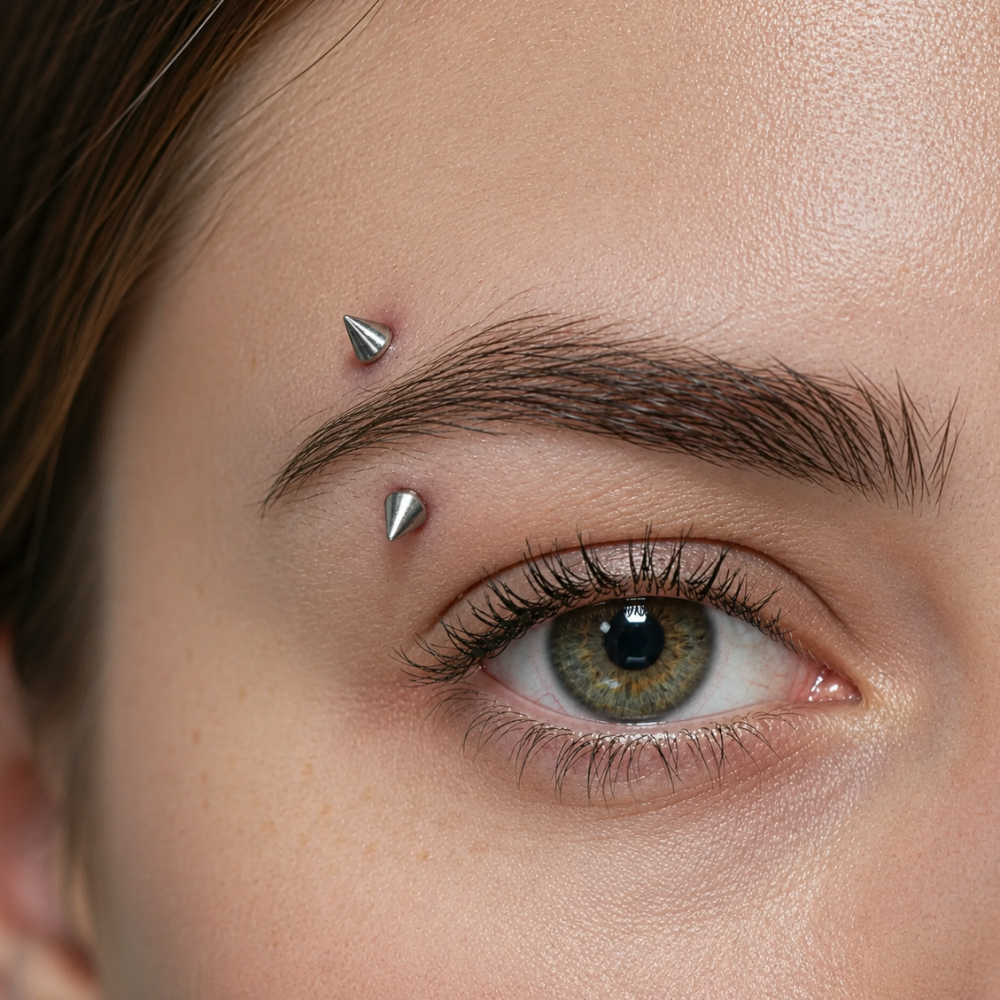
Eyebrow Piercing
Eyebrow piercing it is an absolute classic of the 90s, which is currently experiencing its great, stylish renaissance. Usually located in the outer part of the eyebrow arch, it immediately attracts the eye and adds expressiveness to the face.
However, it is important to remember that eyebrow piercing is technically classified as surface piercing (surface piercing). This means that it has a naturally higher tendency to migrate (be pushed out by the body) than an earlobe or nose piercing. W Piercing Planet we focus on education - we have prepared a guide that will help you safely heal this unique piercing.
What is Eyebrow Piercing?
The treatment involves a vertical (or slightly oblique) piercing of the skin fold on the eyebrow. The insertion and exit of the needle are on the same flat plane of the face.
Anatomy is key: Not every eyebrow is suitable for piercing. For the piercing to be safe and have a chance to last for years, you must have enough loose skin that can be gripped in this place. If your skin on the eyebrow is very tense and adheres tightly to the bone, the risk of your body quickly rejecting the piercing is almost 100%. An experienced piercer always starts by assessing the tissue.
Does eyebrow piercing hurt?
Good news! Eyebrow piercing is widely recognized as one of the least painful facial piercings. The tissue here is soft and flexible, and the pain is usually only mild 2 to 3 on a 10-point scale.
However, you must be prepared for other, completely normal phenomena:
- Bleeding: The eyebrow arch is an area with an extremely strong blood supply. It happens that more blood will appear during the procedure than with other piercings. This is no reason to panic.
- Bruises (Limes): Due to the rich network of blood vessels, bruising or swelling may appear around the eye (so-called "black eye") within 24-48 hours after the procedure. The bruise will heal on its own after a few days.
Healing time and care of eyebrow piercing
Surface piercings do not forgive hygiene mistakes and mechanical damage.
- The initial stage of healing (swelling goes down): from 6 to 8 weeks.
- Complete healing of the canal: from 3 to 4 months (the process of stabilization in the tissue often takes longer).
How to care for a fresh piercing? (Principles of care)
- Don't touch: Avoid touching the earring with dirty hands and refrain from "spinning" it.
- Cleanse regularly: Wash the piercing site 2-3 times a day with sterile saline solution.
- Avoid chemicals: Avoid using hydrogen peroxide, alcohol or antibiotic ointment. They may irritate the wound and delay healing.
- Be careful with your hair and clothes: Make sure that shampoo or conditioner does not remain on the ear after bathing. Be careful when putting on sweaters!
What jewelry for eyebrow piercing?
The eyebrow piercing is in constant, direct contact with tissue that is heavily supplied with blood. We want to make our customers aware that choosing the right material is not a matter of aesthetics, but of health.
Starter jewelry:
It is standard in this piercing curved barbell, i.e. Banana (Curved Barbell).
- Why Tytan G23? Titanium is absolutely the safest material for piercing. Unlike surgical steel, it does not contain harmful nickel admixtures, is 100% biocompatible and drastically reduces the risk of allergic reactions and rejection of the earring. This is the only safe choice to start with!
- Rod Thickness: Standard 1.2 mm.
- Starting Length: Typically 10 mm or 12 mm to account for initial tissue swelling.
Downsize (Shortening the rod): Absolutely critical! Once the swelling subsides, the barbell will begin to protrude significantly from both sides of the skin fold. A long earring will catch on hair and clothes, which will quickly lead to tissue tearing and migration. You need to go to a piercer to shorten the rod (usually to 8 mm or 6 mm).
Decorative jewelry for eyebrow piercing


- Titanium
- Internal Thread
Titanium Banana with Balls - with Internal Thread
Choose your option


- Titanium
- Internal Thread
Titanium Decorative Banana - Balls with zircons
Choose your option


- Titanium
- Internal Thread
Titanium Decorative Banana - Zircons
Choose your option
- Titanium
- External Thread
Titanium Banana with Balls - with External Thread
Choose your option


- Titanium
- Internal Thread
Titanium Banana with Cones - with Internal Thread
Choose your option


- Titanium
- Internal Thread
Titanium Decorative Banana - Three Rhinestones with a Ball
Choose your option
- Titanium
- External Thread
Titanium Banana with Cones - with External Thread
Choose your option


- Titanium
- Internal Thread
Titanium Decorative Banana - Zircon Flower with Ball
Choose your option
Eyebrow piercing - Questions and Stories
Is there a scar left after removing an eyebrow piercing?
Is there a scar left after removing an eyebrow piercing?
Yes. Eyebrow piercing is a surface piercing, which means it always leaves a mark. If you remove a healed piercing voluntarily, two small "dots" resembling enlarged pores will most likely remain. However, if the earring is pulled out (hooked) or undergoes strong migration and the body itself begins to push it out through the skin, a very visible, concave or convex scar may remain, crossing the eyebrow arch.
Can eyebrow piercing damage the nerve and paralyze the face?
Can eyebrow piercing damage the nerve and paralyze the face?
This is one of the biggest myths of the Internet! A professional piercer only pierces the shallow folds of skin (subcutaneous tissue) on the outer part of the eyebrow. The important facial and trigeminal nerves run much deeper beneath the muscles and bones. A properly performed treatment in a professional studio is completely safe and there is no physical possibility of causing facial paralysis.
When can I replace my eyebrow piercing with a shorter one (downsize)?
When can I replace my eyebrow piercing with a shorter one (downsize)?
Shortening the rod is a mandatory point of the program. When the ear, or in this case the eyebrow, is no longer swollen, the starter earring will begin to protrude unsightly (usually after about 4-6 weeks). This is a signal that you need to visit your piercer for the so-called downsize. Too long an earring is the shortest way to catch on shirts and migrate! We recommend that you start replacing decorative caps or changing to another earring on your own only after complete healing, i.e. at least after 3-4 months.
Can I adjust my eyebrows normally after piercing?
Can I adjust my eyebrows normally after piercing?
At first you have to be very careful. During the period of intensive healing (the first 2-3 months), absolutely avoid waxing, threading or applying henna in the immediate vicinity of the piercing to prevent chemicals and impurities from getting into the wound. You can remove the hairs growing right next to the barbell very carefully with tweezers, being careful not to tug at the jewelry.


